Radon dimension pack
View the upgraded "Citizen's Guide to Radon" to find out more concerning evaluating your residence. Radon originates in granite deposits located deeply underground. The gas can enter into buildings by seeping in through fractures in the structure, openings around drains pipes or under basement pieces.
High levels of radon in houses usually come from the surrounding dirt. Radon gas from the soil enters buildings via openings and also fractures. The EPA has determined Putnam County as a "high threat" radon area. Nevertheless, the only means to recognize if you have high radon levels in your house is to check it.
If screening exposes a much greater level, you'll absolutely need mitigation as well as might need more comprehensive renovations to seal off the source of the gas. While any type of degree of radon can have an impact, the EPA says analyses listed below 2 pCi/L is thought about regular and also only lugs a fairly tiny enhanced risk of lung cancer. It's feasible however often challenging to decrease radon gas direct exposure listed below these degrees. Radon originating from the soil beneath homes is a more typical trouble as well as a much larger public wellness danger than radon from granite structure materials.
The threats to your health and wellness from radon
It has actually been suggested that radon is the second crucial variable contributing to lung cancer and is possibly responsible for 20,000 lung cancer cells deaths each year in the USA. As radon gas breaks down, it sends out high-energy alpha particles. These fragments are in the air we take a breath, as well as as soon as breathed in, they can be deposited in our lungs.
According to the Epa, radon is among the most severe health problems encountering our population today. While this gas does not position immediate wellness risks the method carbon monoxide does, with time, radon direct exposure can considerably enhance one's threat for lung cancer. Actually, radon exposure is the second leading reason for lung cancer cells in this country, right behind cigarette smoke. It is odorless, colorless and also chemically inactive, a natural product of the fragmentation of uranium.
Why is radon bad for you?
Radon produces a radioactive dust in the air we breathe. The dust is trapped in our airways and emits radiation that damages the inside of our lungs. This damage, like the damage caused by smoking, increases our risk of lung cancer.
Will opening windows reduce radon?
Opening windows improves air circulation and ventilation, helping move radon http://www.mediafire.com/file/yfipbscwz8kd2i6/354306.pdf/file out of the house and mixing radon-free outside air with indoor air. Opening basement windows helps reduce negative air pressure, diluting radon with clean outdoor air.
How long does radon stay in the air?
It can be found in all 50 states. Once produced, radon moves through the ground to the air above. Some remains below the surface and dissolves in water that collects and flows under the ground's surface. Radon has a half-life of about four days - half of a given quantity of it breaks down every four days.

How long do you have to be exposed to radon before it becomes a problem?
Radon is a radioactive gas and exposure to it causes 21,000 lung cancer deaths per year—only smoking causes more. Because you can't see, smell or taste radon, it's important to periodically test the air in your home. Believing you live in a region not affected by radon is just one of the myths about this deadly gas.
How much does radon cost per gram?
Radon is available at a cost of about $4/mCi.
- The Canadian guideline for radon in interior air for dwellings is 200 Becquerels per cubic metre (200 Bq/m3).
- Over the years, data that tracks radon levels indicates that a large percentage of Pennsylvania homes have a serious radon trouble.
- Radon gas is dangerous, and also if the problem goes without treatment, the radon focus continues to climb inside your home.
- Radon gas enters your residence or various other home from the outdoors, as well as gradually, progressively builds up to unsafe degrees that can lead to an increased risk of lung cancer or respiratory system concerns.
What causes radon?
Being exposed to radon for a long period of time can lead to lung cancer. Radon gas in the air breaks down into tiny radioactive elements (radon progeny) that can lodge in the lining of the lungs, where they can give off radiation. This radiation can damage lung cells and eventually lead to lung cancer.
Is it hard to sell a house with radon?
Fortunately, it's not hard to sell a house with radon, provided that you alert potential buyers and mitigate the problem, say Brian Thomas, a top real estate agent in the Denver, Colorado area, with 16 years of experience. “For as much fear and uncertainty as radon causes, there's an easy fix.”
How do I make my house safe from radon?
Install a layer of gas-permeable aggregate, such as four inches of gravel, beneath the slab or flooring system of your home if you don't have a crawlspace. Cover this layer or your crawlspace floor with plastic sheeting to stop radon gas from moving past that level and into your home.
How do you eliminate radon?
If a person has been exposed to radon, 75 percent of the radon progeny in lungs will become "harmless" lead particles after 44 years. When an alpha particle damages a cell to make it cancerous, the onset of lung cancer takes a minimum of 5 years but most often 15 to 25 years, and even longer.
Is radon only in the basement?
Radon is completely odorless as well as being invisible. Because it is often found unexpectedly in basements, some people mistakenly believe that it only occurs in basements. Most commonly homes with basements are suspect for having higher radon levels.
How common is radon in a home?
It's common: About 1 in every 15 homes has what's considered an elevated radon level. The gas is odorless and invisible, says the EPA, and it causes no immediate symptoms, so the only way to know if your home is affected is by testing your individual residence.
Is radon something to worry about?
The average home has about 1.3 pCi/L of radon. Such levels aren't enough to worry about, but under the right conditions, they could make you sick. According to the EPA, a nonsmoker who was exposed to average levels of radon for a lifetime would have a 1 in 500 risk of developing lung cancer.
Is radon heavier than air?
Radon gas is approximately 7.5 times heavier than air. It is however a noble gas with no chemical affinity but is easily influenced by air movements and pressure. In a house with forced air heating and cooling, radon gas can easily be distributed throughout the entire dwelling.
Is a radon level of 5 bad?
Safe radon levels. The best radon level measurement would be zero. The average global outdoor radon level varies between 5-15 Bq/m3, equal to 0.135-0.405 pCi/L. For every 99.9 Bq/m3, or every 2.7 pCI/L increase in long term Click for info radon exposure, lung cancer risk rises 16 percent.
Can I install my own radon mitigation system?
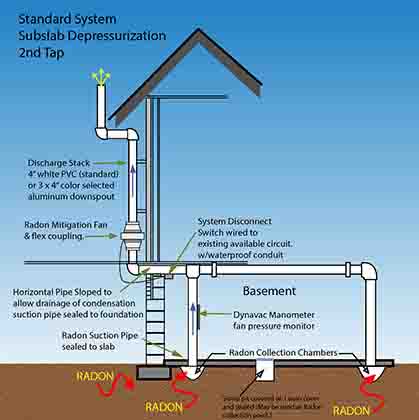
In most cases, pros charge about $1,500 to install a radon mitigation system, but you can do it yourself for only about $500 in materials. So if you're fairly handy and have some carpentry, plumbing and electrical skills, you can install your own system in a weekend and save yourself a thousand bucks!